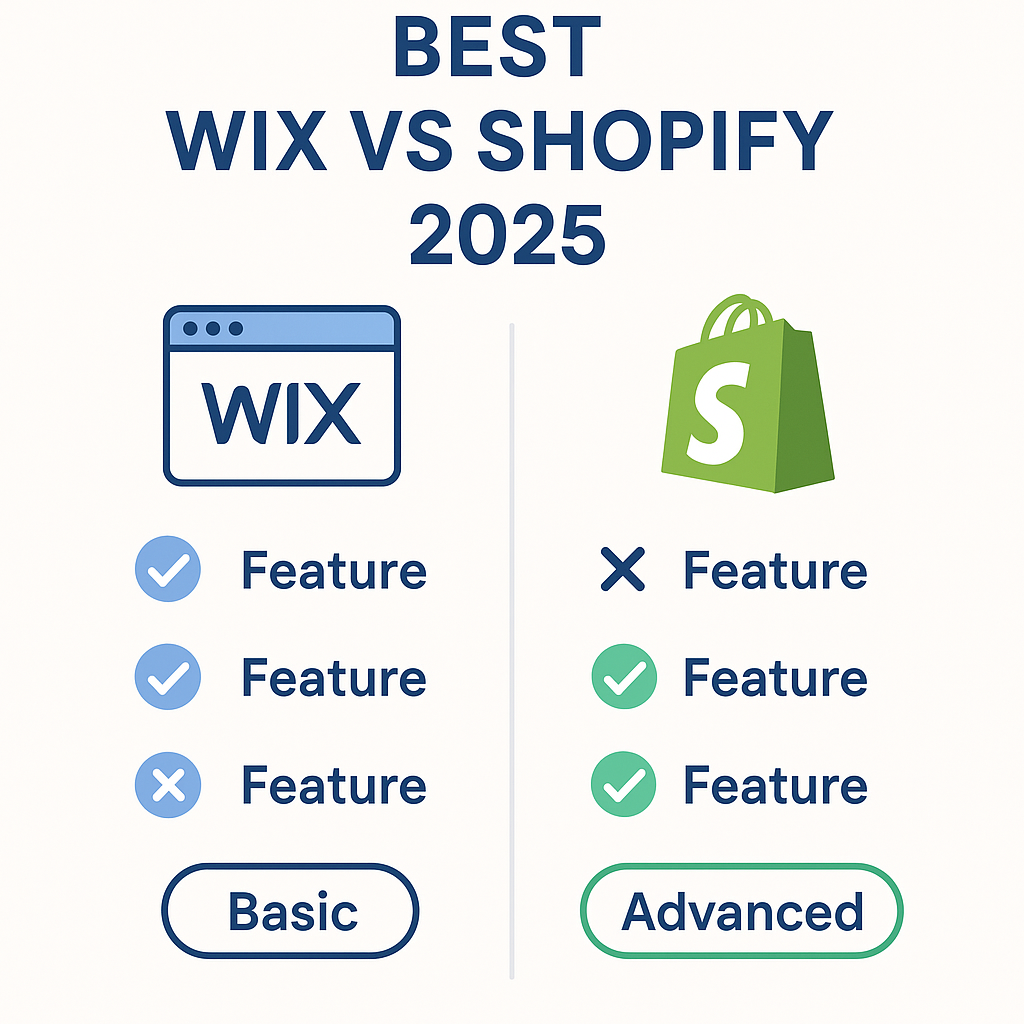
Wix vs Shopify 2025: Which Platform Is Best for You?
Finding the best Wix vs Shopify 2025 answer is one of the most common dilemmas facing anyone who wants to build a website or online store today. Both platforms are genuinely powerful, widely used, and capable of helping you create a professional online presence — but they were built with different goals in mind, and choosing the wrong one can cost you time, money, and unnecessary frustration down the line. Wix started as a general-purpose website builder and has steadily expanded its eCommerce capabilities. Shopify was purpose-built for selling products online from day one, and it shows in nearly every corner of the platform. The challenge is that neither platform is universally “better” — the right choice depends entirely on what you’re building, how you expect your business to grow, and what matters most to you as the person managing the site day-to-day. In this guide, you’ll get a thorough, honest comparison of both platforms across every dimension that matters: pricing, ease of use, eCommerce tools, design flexibility, SEO, and integrations. By the end, you’ll have a clear, confident understanding of which platform fits your specific situation — without needing to rely on vague advice or marketing promises from either company.
—
What Is Wix and Shopify, and How Do They Work?
Both Wix and Shopify are cloud-based website platforms, which means you don’t need to install any software, manage a server, or know how to write code to use them. You sign up, choose a plan, pick a design template, and start building your site through a browser-based editor. Think of them like digital storefronts you can rent and furnish — the building (hosting, security, infrastructure) is already taken care of, and you just arrange the interior.
Wix works through a visual drag-and-drop editor. You click on any element on your page — a heading, an image, a button — and move it wherever you like, resize it, or change its appearance. This makes Wix feel a lot like using a digital design tool, where what you see on screen is almost exactly what your visitors will see. It’s an approach that appeals to people who think visually and want granular control over how every part of their site looks.
Shopify works differently. It uses a more structured, template-based system where the overall layout is defined by your chosen theme, and you customise within that framework. It’s less like freeform design and more like filling out a well-organised form. This structure might feel slightly limiting at first, but it exists for a reason: Shopify’s architecture is optimised for eCommerce performance, fast loading, and clean checkout flows. A small clothing brand called Ridge & Thread, for example, could launch a full product catalogue with size variants, inventory tracking, and an integrated payment system on Shopify within a single afternoon — without writing a line of code.
Both platforms handle hosting, SSL certificates, and security automatically, making them genuinely accessible to non-technical users.
—
Pricing Comparison: Wix vs Shopify 2025
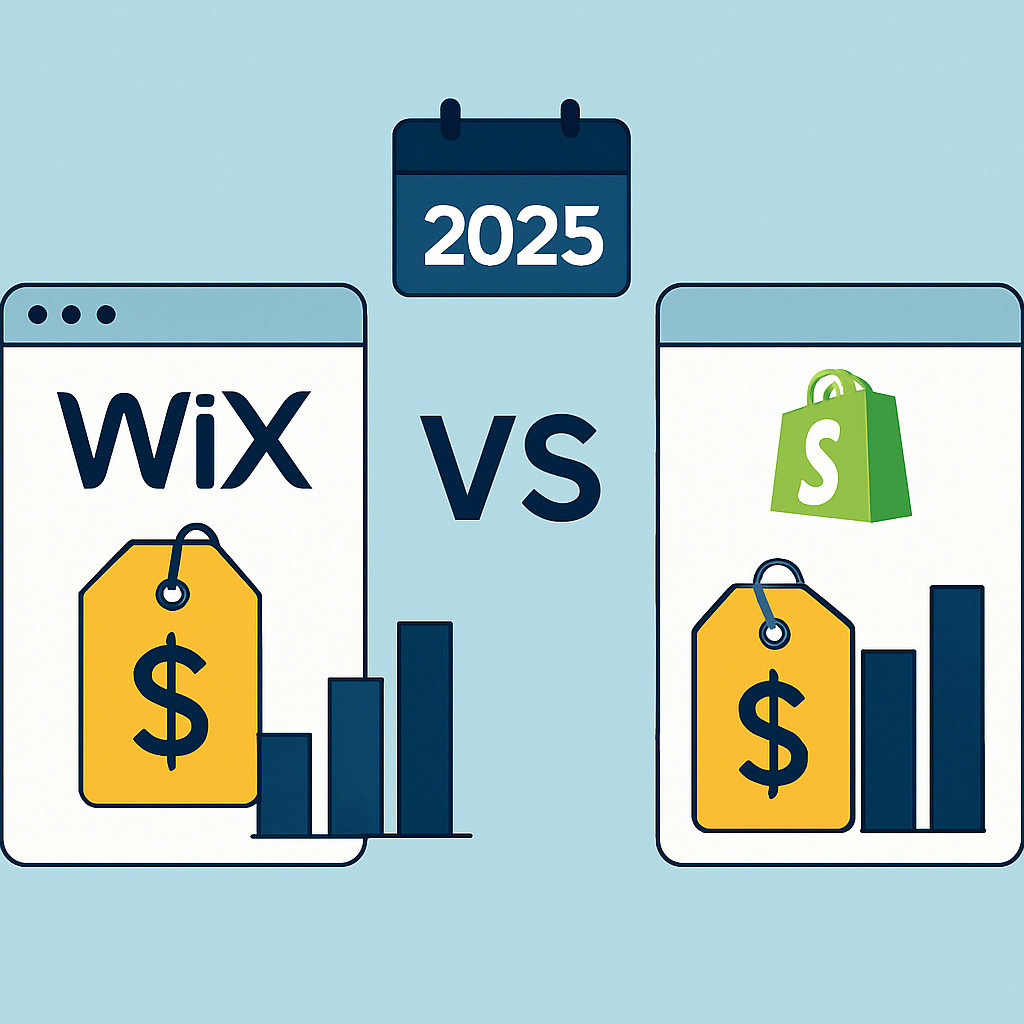
Wix Pricing Plans Breakdown
Wix offers several tiers, and the pricing depends on what you need. As of 2025, Wix’s plans range from a free plan (which includes Wix branding and limited features) through to Business and Business Elite tiers designed for eCommerce. The Light plan starts at around $17/month and is suitable for basic websites. The Core plan at around $29/month introduces eCommerce functionality. The Business plan at around $36/month is where most small online store owners land, and Business Elite — designed for high-volume operations — sits at the top of the range.
For a freelance photographer selling prints online, Wix’s Core or Business plan offers a very cost-effective way to accept payments without paying a premium for advanced selling tools they don’t need yet.
Shopify Pricing Plans Breakdown
Shopify’s pricing in 2025 starts at the Basic plan at approximately $39/month, with the Shopify plan at around $105/month and Advanced Shopify at approximately $399/month. There is also Shopify Starter (around $5/month) for selling through social media or existing websites without a full storefront, and Shopify Plus for enterprise-level businesses at a much higher price point.
The difference in entry price between Wix and Shopify reflects Shopify’s deeper focus on eCommerce infrastructure. You’re paying for features like advanced shipping calculators, professional reporting, and multi-channel selling that simply aren’t present in Wix’s lower tiers.
Hidden Costs and Transaction Fees
This is where many new users get caught off guard. Shopify charges a transaction fee on every sale — typically 2% on the Basic plan, 1% on the Shopify plan, and 0.5% on Advanced — unless you use Shopify Payments as your payment processor. If you want to use PayPal, Stripe, or another gateway, those fees apply on top of whatever the gateway charges. For a store doing $10,000/month in sales, a 2% transaction fee adds $200/month directly to your costs.
Wix does not charge additional transaction fees beyond what your chosen payment provider charges. This makes Wix meaningfully more affordable for lower-volume stores that want to avoid building fee costs into their margins.
—
Ease of Use: Which Platform Is Beginner-Friendly?
Wix Drag-and-Drop Builder
Wix’s editor is genuinely one of the most intuitive website-building experiences available today. When you start a new site, you can choose to have Wix’s AI builder generate a starting design based on your answers to a few questions, or you can pick a template and customise it manually. Every element on the page is independently moveable. Want to shift your contact form three inches to the left and add a decorative divider below your headline? You can do that in seconds.
For a local yoga studio owner who has never built a website before, Wix makes it possible to have a professional-looking site with a booking form and class schedule live within a few hours — no technical background required.
Shopify Store Setup Experience
Shopify’s onboarding experience is structured and guided. When you create a new store, Shopify walks you through adding your first product, setting up payment methods, and configuring shipping before you launch. The dashboard is clean and logically organised, with separate sections for orders, products, customers, analytics, and marketing.
The trade-off is that Shopify’s theme editor, while improved significantly in recent years with its “Online Store 2.0” system, still feels more constrained than Wix. You customise within defined sections rather than moving anything anywhere. For an eCommerce-focused user, this structure is actually a benefit — it keeps your store looking consistent and loading quickly. But for someone who wants pixel-perfect design control over a content-heavy site, it can feel limiting.
—
eCommerce Features Compared
Product Management and Inventory
Shopify’s product management system is genuinely comprehensive. You can add products with multiple variants (size, colour, material), set inventory levels, receive low-stock alerts, and sync across multiple sales channels including Amazon, Instagram, and your physical store via Shopify POS. A business selling handmade candles in 12 scents and three sizes would be managing 36 product variants — Shopify handles this effortlessly.
Wix’s product management has improved considerably, and for stores with a straightforward catalogue, it works well. However, for complex inventory scenarios or high-volume multi-channel selling, Wix begins to show its limits.
Payment Gateways and Checkout
Shopify supports over 100 payment gateways globally and has its own payment solution (Shopify Payments) built in, which eliminates transaction fees. The Shopify checkout is widely considered one of the highest-converting in the industry, with a clean, fast, mobile-optimised flow.
Wix supports major payment providers including PayPal, Stripe, and Wix Payments, which is solid for most use cases. However, the breadth of international payment options doesn’t quite match Shopify’s reach, which matters if you’re selling globally.
Abandoned Cart and Marketing Tools
Both platforms include abandoned cart recovery tools — the ability to automatically email customers who added items to their cart but didn’t complete a purchase. Shopify’s version is robust and available even on the Basic plan. Wix includes it on their Business tier and above.
Shopify’s email marketing tools and integrations with platforms like Klaviyo and Mailchimp are particularly strong, making it easier to run sophisticated campaigns. Wix Email Marketing is a capable tool for smaller businesses that prefer everything in one place.
—
Design and Customization Flexibility
Wix Templates and Design Freedom
Wix offers over 800 templates covering virtually every category — restaurants, portfolios, fitness studios, online stores, event pages, and more. Because Wix’s editor allows free-form placement of any element, the design possibilities are genuinely broad. A graphic designer building a portfolio site could create something that looks truly distinctive, not like a standard template.
The caution here is that Wix’s design freedom comes with a responsibility: if you move things around without a strong sense of design principles, you can end up with a site that looks cluttered or inconsistent. Freedom without guidance can be a double-edged tool.
Shopify Themes and Storefront Customization
Shopify’s theme store offers free and paid themes, with premium themes typically costing between $100–$400 as a one-time fee. These themes are purpose-built for online stores, with product pages, collection layouts, and checkout flows already optimised.
The newer Shopify Online Store 2.0 themes allow you to move sections around on any page (not just the homepage), which significantly increased Shopify’s design flexibility in recent years. A specialty outdoor gear retailer could configure their homepage to feature seasonal collections, video banners, and customer review highlights without touching a line of code.
—
SEO and Marketing Capabilities
Both platforms have invested significantly in their SEO tools over the past few years, and both are capable of ranking in search engines when used correctly. Shopify has a slight structural advantage for eCommerce SEO: its URL structures for product pages are clean and consistent, its built-in schema markup helps search engines understand your product data, and its speed — optimised for commerce — is a ranking factor in its favour.
Wix has addressed its historical SEO limitations aggressively. In 2024 and into 2025, Wix added better canonical tag controls, improved crawl settings, and more robust meta tag management. For a service-based business or content-heavy site, Wix’s SEO capabilities are genuinely competitive. Shopify’s blogging tool, while functional, is less flexible than Wix’s content pages, which matters for businesses that rely heavily on content marketing to drive organic traffic.
—
App Stores and Integrations
Both platforms have extensive app ecosystems. Shopify’s App Store contains thousands of apps covering everything from loyalty programmes and subscription billing to advanced shipping management and wholesale pricing tools. The depth and maturity of Shopify’s app ecosystem is hard to match — it reflects years of developer investment because Shopify merchants represent a lucrative, large-scale market.
Wix’s App Market has grown meaningfully and includes tools for booking, events, email marketing, forms, and social feeds. For most small to mid-sized sites, you’ll find what you need. However, if you’re looking for highly specialised eCommerce integrations — like complex B2B pricing tiers or advanced multi-warehouse inventory management — Shopify’s ecosystem is significantly richer.
—
Who Should Choose Wix in 2025?
Wix is the stronger choice for you if your primary goal is building a beautiful, content-rich website with eCommerce as a secondary or supplementary function. This includes service providers like photographers, consultants, therapists, or restaurants who want to sell gift cards or merchandise but whose main business isn’t transactional. It also suits very small online stores where simplicity, design flexibility, and a lower monthly cost are priorities.
If you want full creative control over every visual element of your site, Wix’s drag-and-drop builder offers something Shopify simply can’t match. And if you’re budget-conscious and don’t plan to scale to high sales volumes quickly, Wix’s lower pricing and no-transaction-fee structure makes it genuinely more economical.
—
Who Should Choose Shopify in 2025?
Shopify is the right choice if selling products online is the core function of your business and you intend to grow. It’s built for eCommerce in a way that shows in every feature: the checkout, the inventory system, the marketing integrations, the multi-channel selling, and the scalability. A business starting with 20 products but planning to expand to 500, or one that wants to sell on Instagram, Amazon, and a physical storefront simultaneously, will find Shopify’s infrastructure far more capable.
Shopify is also the better choice if you’re in a high-volume selling scenario where a professional, conversion-optimised checkout process has a measurable impact on your revenue. For merchants who take their eCommerce seriously — even at a small scale — Shopify’s tools justify the higher price point.
—
Pros and Cons
Wix
Pros
- Unmatched design freedom: The drag-and-drop editor gives you more visual control than almost any other platform at this price point, making it ideal for design-conscious users.
- Lower starting cost: Wix’s eCommerce tiers are priced below Shopify’s equivalent plans, which matters for early-stage businesses watching every dollar.
- No transaction fees: Beyond your payment gateway’s standard charges, Wix doesn’t take a cut of your sales, which can add up significantly over time.
- All-in-one versatility: Wix handles content sites, portfolios, service businesses, and stores equally well, making it a genuinely multi-purpose platform.
Cons
- Limited scalability for large stores: Wix begins to strain at high product volumes or complex inventory needs, where Shopify’s infrastructure handles things more smoothly.
- Less mature eCommerce ecosystem: Wix’s app market doesn’t yet match Shopify’s depth for specialised commerce integrations.
- Design freedom can be a pitfall: Without design experience, the open-ended editor can produce inconsistent results that require additional effort to polish.
—
Shopify
Pros
- Purpose-built for eCommerce: Every feature, from checkout to inventory to marketing, is designed around selling, which shows in the quality and depth of the tools.
- Massive app ecosystem: Thousands of integrations mean you can add almost any functionality your business needs as it grows.
- Superior multi-channel selling: Shopify connects natively to Amazon, Instagram, TikTok Shop, Facebook, and in-person via POS — genuinely powerful for omnichannel businesses.
- Highly scalable: Shopify handles businesses from a single product to enterprise-level catalogues and transaction volumes without breaking a sweat.
Cons
- Transaction fees unless using Shopify Payments: For stores using third-party payment gateways, the additional percentage fee can be a meaningful cost that compounds quickly.
- Higher base cost: Shopify’s plans start higher than Wix’s eCommerce tiers, making it less accessible for very small or early-stage businesses.
- Less design flexibility: Shopify’s section-based editor, while improved, still doesn’t offer the pixel-level control that Wix’s drag-and-drop system provides.
—
Frequently Asked Questions
Is Wix or Shopify better for a small business in 2025?
The answer depends on what your small business primarily does. If your business revolves around services, content, or a small product catalogue, Wix is often the better fit because it’s more affordable, easier to design, and doesn’t require the overhead of a dedicated eCommerce platform. If your small business is fundamentally a retail operation — even if it’s small now but you expect it to grow — Shopify’s eCommerce infrastructure, professional checkout, and selling tools will serve you better in the long run. Consider where you expect to be in two years, not just where you are today, because migrating platforms is a significant undertaking.
Is Shopify more expensive than Wix?
In most comparable scenarios, yes. Shopify’s Basic plan starts at approximately $39/month, which is higher than Wix’s entry eCommerce plans. Beyond the base cost, Shopify adds transaction fees of up to 2% per sale if you don’t use Shopify Payments — a cost that has no equivalent on Wix. However, the cost comparison becomes more nuanced at higher sales volumes, where Shopify’s superior conversion tools and checkout performance can result in meaningfully higher revenue that more than offsets the price difference.
Can I switch from Wix to Shopify later?
Yes, migration is possible, but it’s not a one-click process. Wix allows you to export your product data as a CSV file, which Shopify can import — this gets your product catalogue across relatively painlessly. However, your site design, page content, blog posts, and customer data require manual rebuilding in Shopify’s environment. Third-party migration services and apps like LitExtension can simplify the process, but expect to invest time in reviewing and cleaning up the migrated data. Planning ahead — keeping your product data well-organised and documented — makes any future migration significantly easier.
Which platform is better for SEO, Wix or Shopify?
Both platforms are capable of achieving strong search engine rankings when used correctly, and both have improved their SEO tools substantially in recent years. For eCommerce-specific SEO — ranking product pages and collection pages for commercial keywords — Shopify has a structural edge, with cleaner URL patterns, automatic sitemap generation, and strong schema markup for products. For content-driven SEO — ranking blog posts and informational pages — Wix’s more flexible page builder can actually be advantageous because it gives you more control over how content is laid out. Neither platform will automatically rank your site; both require consistent effort on content quality, backlinks, and technical optimisation.
Does Wix support large online stores?
Wix is well-suited for small to mid-sized stores, and many businesses with several hundred products operate comfortably on the platform. However, Wix’s infrastructure begins to show limitations at genuinely high product volumes, high transaction rates, or complex inventory scenarios involving multiple warehouses or wholesale pricing tiers. If you’re planning a store with thousands of SKUs, heavy seasonal traffic spikes, or complex multi-location inventory management, Shopify’s architecture is purpose-built for those demands and will handle them more reliably. Wix is excellent within its range — it’s just a narrower range than Shopify’s.
Which is easier to use, Wix or Shopify?
For absolute beginners with no prior experience, Wix’s drag-and-drop editor is generally considered the more intuitive starting point because it lets you interact with your site visually in a very direct way — click, move, resize, done. Shopify has a slightly steeper initial learning curve because you’re working within a more structured system, and understanding concepts like themes, sections, and apps takes a little time. That said, Shopify’s guided onboarding and logical dashboard layout mean that most users feel comfortable within a few days. If your background is in design, Wix will feel immediately natural. If your background is in retail or business operations, Shopify’s organised, task-focused dashboard will likely make more intuitive sense.
—
Conclusion
Choosing between Wix and Shopify in 2025 comes down to understanding your own priorities clearly. Wix is a flexible, affordable, and visually powerful platform that suits content-rich websites, service businesses, and smaller online stores where design freedom and cost-efficiency matter most. Shopify is a focused, scalable eCommerce engine that suits businesses where selling products online is the central activity — especially those planning to grow, sell across multiple channels, or handle significant transaction volumes.
Neither platform is the wrong choice in the abstract. The wrong choice is the one that doesn’t match your actual needs. If you’re still unsure, consider this practical approach: think about what percentage of your site’s purpose is selling versus informing or showcasing. If selling is the dominant function, lean toward Shopify. If it’s one of several functions, Wix is likely the more flexible and economical fit.
Both platforms offer free trials or entry-level plans that let you explore before committing. The best way to form a genuine opinion is to spend an hour inside each editor building a sample page. The one that feels right to you — the one where you spend less time fighting the tools and more time building — is almost certainly the right platform for your project.